
UGR GLARE FACTOR
How UGR values influence lighting quality and comfort at the workplace

UGR glare factor in a nutshell:
The UGR glare factor (Unified Glare Rating) is used to assess the psychological glare caused by light sources at the workplace.
The European standard EN 12464 specifies the limit values for various visual tasks. Compliance with these limit values and the use of low-glare lighting can increase employee concentration and productivity.
UGR - glare factor explained simply

Put simply, the lower the value, the lower the glare
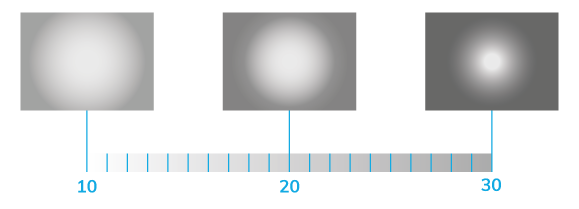
UGR values and their application in the working environment
The international unified UGR method (Unifi ed Glare Rating) seeks the uniform evaluation of discomfort glare by lighting systems, natural light and light sources by reflecting surfaces at the workplace. The European standard EN 12464 describes the UGR limits to be observed for certain visual tasks in different work areas. When calculating the UGR value, both direct glare and indirect or reflected glare must be considered. Direct glare arises from natural and artificial light sources; however, indirect glare is the reflection of light on e.g., monitors, large walls, ceilings, glass surfaces, furniture etc. and, therefore, also contributes to the glare sensation.
| UGR LIMITS (UGR) (A COMPLETE LIST OF UGR LIMITS FOR ACTIVITIES AND VISUAL TASKS IS PROVIDED BY THE STANDARD EN 12464) | |
| Technical drawing | ≤ 16 |
| Work on the PC, reading and writing | ≤ 19 |
| Craft and industry | ≤ 22 |
| Indoor swimming pool | ≤ 28 |
Glare-free working: The importance of UGR-optimized lighting
Affected by direct and indirect glare
Direct glare arising from non-glare-free lighting and unobstructed sunlight strain vision and lead to fatigue. As a result, concentration lapses and the risk of making mistakes Increase. For physical work, this leads to increased risk of accidents. For this reason, we must use lights with appropriate glare ratio, install sunshades on windows, and redesign the workspace arrangement appropriately.
Supports UGR-optimised lighting
Indirect lighting, matt fixtures with low light reflection, workspace division adapted to light sources, and the elimination of specular surfaces avoid burdensome reflected glare. Thus, concentration is maintained for longer periods, which leads to higher productivity.
To reduce glare, luminaires with a low glare factor should be used and sun protection measures taken. Indirect lighting and matt surfaces also help to minimize reflected glare.
Standardized room size

The UGR value is a value that refers to a standardized room size. In practice, however, it is always dependent on many factors such as the room size, the luminaire position, the reflectance of the ceilings, the walls and the installation angles.
Evaluation and differentiation of LED panels for open-plan offices and classrooms
Panels with UGR <19 at 2H and opal surface
Features
- UGR <19 at 2H:
These panels still achieve a glare rating of less than 19 when the light source is removed further away from the viewer. - Opal surface:
Provides uniform light distribution, but can cause more glare when viewed directly.
Evaluation for open-plan offices
- Advantages:
Uniform light distribution that provides pleasant illumination for workstations. - Disadvantages:
The opal surface can lead to higher glare when viewed directly, which is less ideal for VDU workstations. - Recommendations:
These panels are acceptable if the light sources are not directly in the employees' field of vision. For optimum working conditions, the direct view of the light-emitting surface should be minimized.
Evaluation for classrooms
- Advantages:
Uniform light distribution, good for general illumination of the room and visibility on blackboards and work materials. - Disadvantages:
Can cause more glare when viewed directly, but less critical than for VDU workstations. - Recommendations:
These panels are well suited for classrooms as the even light distribution is important for visibility in the entire room. Direct glare can be minimized by placing the light sources outside the students' direct field of vision.
Panels with UGR <19 at 8H and prismatic surface
Properties
- UGR <19 at 8H:
These panels also achieve a glare rating below 19 when the light source is positioned closer to the observer. - Prismatic surface:
Reduces glare when viewed directly and provides better light distribution.
Evaluation for open-plan offices
- Advantages:
Reduced glare when viewed directly, which improves visual comfort at VDU workstations. - Disadvantages:
No significant disadvantages, particularly when direct glare needs to be avoided. - Recommendations:
These panels are ideal for open plan offices with VDU workstations as they increase visual comfort and reduce eye strain from glare.
Evaluation for classrooms
- Advantages:
Reduced glare when viewed directly, improving concentration and visual comfort for students. - Disadvantages:
No significant disadvantages. - Recommendations:
These panels are also very suitable for classrooms as they improve visual comfort and reduce direct glare, making for a pleasant learning environment.
Summary and recommendation:
For open-plan offices
Prismatic panels with UGR <19 at 8H are the better choice as they minimize glare when viewed directly, significantly improving visual comfort for VDU workstations.
For classrooms
Prismatic panels with UGR <19 at 8H are preferable as they improve visual comfort and reduce glare, creating a pleasant learning environment.
Opal panels with UGR <19 at 2H are also suitable, particularly if the light sources can be placed outside the students' direct field of vision.
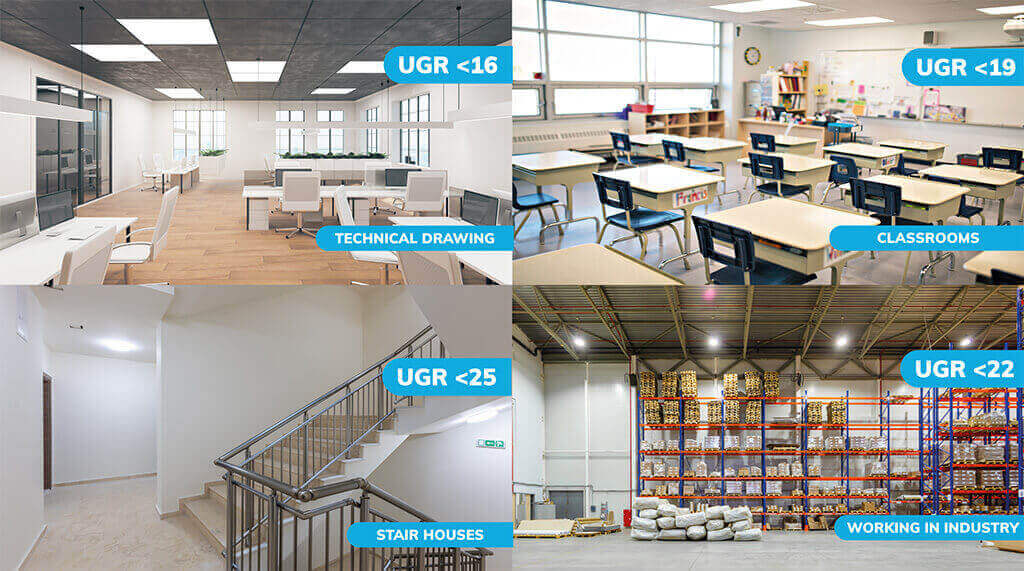
The UGR value takes into account both direct and indirect glare from light sources and reflective surfaces, enabling a comprehensive assessment of the quality of light at the workplace. The EN 12464 standard defines specific UGR limit values for different working environments, such as technical drawings (≤16) or working at a PC (≤19).
Application of UGR values in the working environment



Your Questions About UGR Glare Factor Answered
The UGR (Unified Glare Rating) is an internationally standardized method for assessing psychological glare caused by light sources in the workplace. It considers both direct and indirect glare and is defined in the European standard EN 12464.
A low UGR value (below 19) ensures a comfortable and focused working environment. High UGR values can lead to eye strain, headaches, and reduced productivity.
Technical drawing: ≤ 16
Computer work, reading, writing, educational settings: ≤ 19
Craft and industry: ≤ 22
Halls: ≤ 28
The UGR value is calculated using a complex formula that takes into account factors such as the luminance of the light source, the angle of incident light, the background illumination, and the observer’s position.
Direct glare: originates from natural and artificial light sources.
Indirect glare: occurs through reflection of light from surfaces such as monitors, walls, ceilings, or furniture.
Room size, fixture placement, reflection rates of ceilings, walls, and furniture, as well as the mounting angle of luminaires, all have a significant influence on the UGR value.
LED luminaires with a low UGR value reduce glare and thus improve visual comfort in the workspace. They are especially important in areas where people work or study for extended periods.
The surface finish affects light distribution and therefore the UGR value. Opal surfaces can provide uniform light distribution but may cause more glare under direct observation.
ISOLED offers LED panels with optimized optics and glare control that minimize the UGR value, creating a comfortable working environment.
Yes, a UGR value below 19 is recommended for screen workplaces to avoid glare and promote concentration.
In addition to choosing suitable luminaires, sun protection measures, indirect lighting, and matte surfaces can help minimize reflective glare.
Do you have any questions?
If you have any questions about UGR - aperture factor, we are here for you! Fill out our form and we will get back to you as soon as we have processed your enquiry.
Register now!
Register and take advantage of the many exclusive benefits and discounts for ISOLED customers.