
LED Flexible Strips and Profiles: Combining Durability and Efficiency
Professional lighting solutions with LED flexstrips and ALU profiles
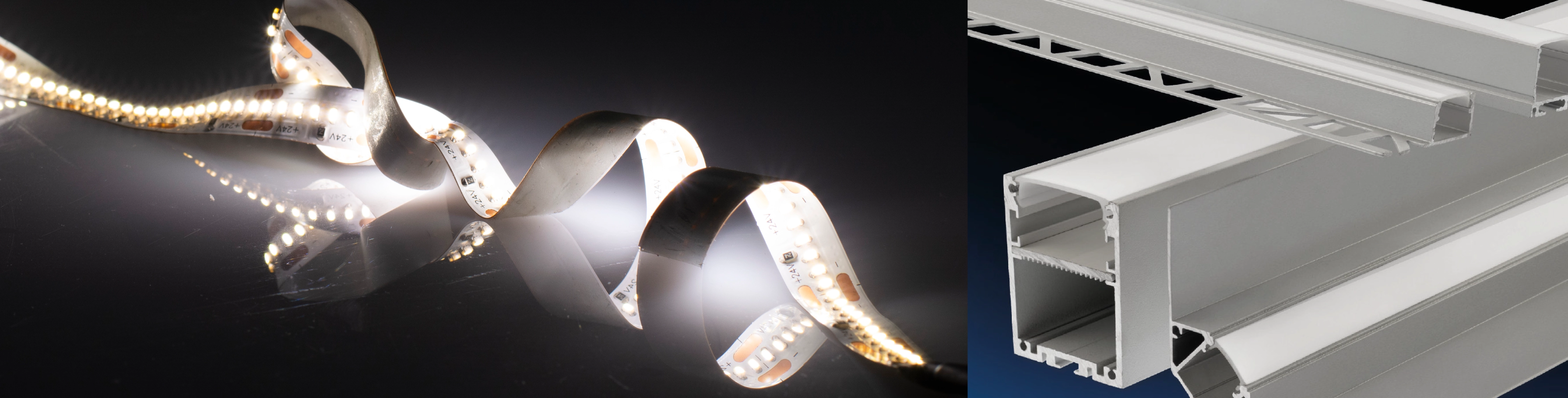
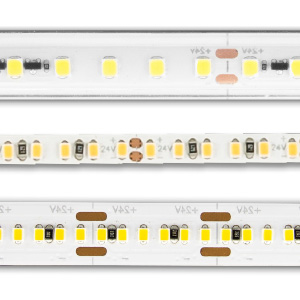
ISOLED® offers more than 300 different versions of high-quality LED flex strips.
Our LED strips are particularly characterised by constant power values, LED chips of the latest generation, high colour rendering and sustainable electronics.
LED flex strips with very high chip density, extremely narrow flex strips for e.g. installation in furniture or constant current strips that require only one feed over a length of up to 15 m - these are just a few examples from our wide range of perfect light lines for every lighting concept. These are just a few examples of our wide range of perfect light lines for every lighting concept.
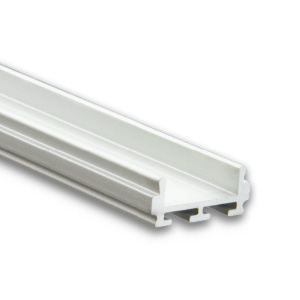
For professional and safe installation of LED flex strips, we recommend the use of aluminum profiles. There are over 500 different profiles made of anodised aluminum and matching covers (transparent to opal or coloured) to choose from.
Perfect LED light lines for indoor and outdoor use.
We advise you!
Our LED interior lighting products
CUSTOM LED
Prefabricated lighting elements
Precise manufacturing
Delivery ready for installation
PRECISE - FAST - RELIABLE
The advantages of our LED profiles
Premium PUR-Casting for absolute tightness (IP68) -
possible for all profile systems
Covers made of flame retardant polycarbonate
OEM production of individually designed aluminum profiles
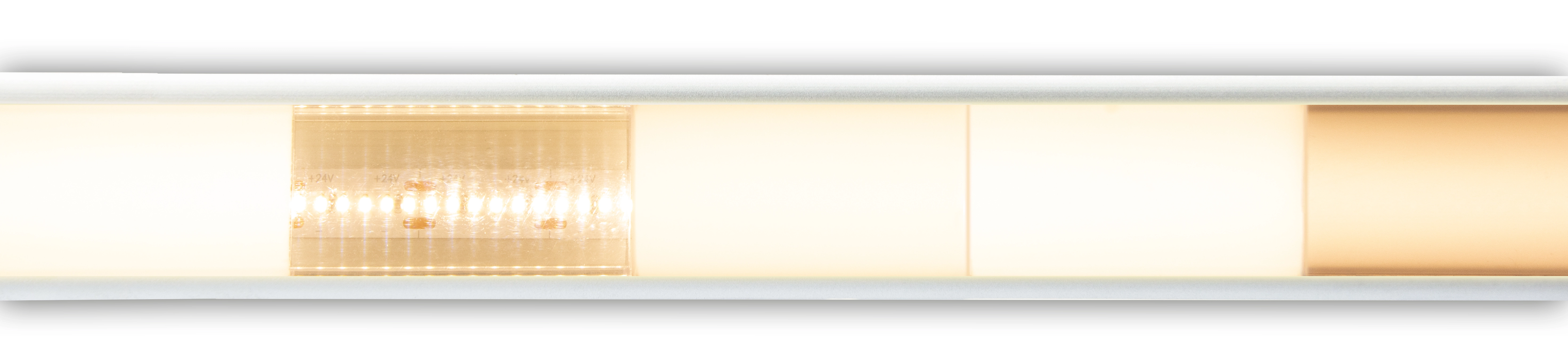
The advantages of our LED flex stripes
Excellent colour rendering index
Universal & highest flexible adjustment
LED high-end products with high-power LED chip
The right lighting for your industry


Frequently Asked Questions about Flex Strips & Profiles
LED flex strips are available in various widths, typically between five and fourteen millimeters. Standard widths are eight, ten, and twelve millimeters, while waterproof versions with encapsulation can be slightly wider. For example, a waterproof RGB flex strip in the encapsulated version has a width of fourteen and a half millimeters, whereas the base version without encapsulation measures twelve millimeters. Standard roll length is five meters, with some versions, such as the linear 48V variants, also available in rolls of twenty or thirty meters. Mechanical flexibility varies depending on the design. Standard flex strips can be bent and adapted to contours without difficulty. For particularly tight radii, there are special flexible profiles as an alternative to rigid versions. Some products, like the Skyflex system, are based on powder-coated stainless steel flat strips, offering different bending properties. Not all strips are suitable for extreme bending – in encapsulated versions, strong bending can stress the material and compromise the adhesive bond.
The range of available protection classes covers all application areas. IP20 is intended for dry indoor spaces and provides no water protection. IP44 protects against splashing water and is suitable for humid rooms such as bathrooms, although a bathroom is not technically classified as a humid room, as moisture occurs only temporarily. IP54 and IP66 offer increased protection against jetting water and are used for more demanding environments. For outdoor applications, IP65 or higher is recommended. IP67 protects against temporary immersion but is not suitable for permanent water exposure. For underwater applications in pools or aquariums, IP68 is mandatory. There are differences in execution: fully encapsulated versions provide true waterproofing for underwater use, while hollow extruded versions may allow water to enter through small gaps. For chlorine- and saltwater-resistant applications on yachts or in swimming pools, specially developed versions with polyethylene encapsulation are suitable, as silicone may cloud over time due to chlorine exposure.
Customization includes cutting to individual lengths, soldering of connection cables, and assembly of connectors. Flex strips can only be cut at marked cutting points, typically every 25 to 50 millimeters – for 12V, closer spacing is possible than for 24V. Cutting elsewhere would damage the electrical circuit. Various methods are available for connection after cutting. Soldering is preferred, as it produces the lowest contact resistance. Alternatively, connectors of different types can be used: K-connectors with through-contacting pins, C-connectors with surface contacts, and O-connectors for waterproof outdoor applications. Connector coding indicates the number of poles and strip width.
Heat dissipation is critical for the lifespan and reliability of LED flex strips. Aluminum profiles serve as the primary heat sink and should always be used with high-power strips. The cooling capacity of a profile can be inferred from the weight per meter – typical profiles provide about 225 grams per meter. When multiple strips are mounted in a profile, the power and thus heat generation add up. A profile with two 11W strips must dissipate 22W. The profile must be appropriately dimensioned. The maximum power per meter depends on the profile type, e.g., 28W for certain mounting profile types. The chip temperature should not exceed 65°C, as higher temperatures drastically shorten lifespan. Mounting on thermally conductive surfaces with direct contact is essential. Magnetic tape is unsuitable, as it increases thermal resistance and voids the warranty. Protective paper from adhesive tapes must not remain between the strip and profile. For high ambient temperatures or constant sunlight, special high-temperature series are available for elevated operating temperatures.
Most profile systems are modular and can be expanded later. Various connectors are available to connect profile segments, including straight, T-, and corner connectors. For power rails, the neutral conductor position must be observed, always on the inside for T-connectors. LED flex strips can be extended or combined using soldering or connectors. The rule of thumb for maximum load per feed point is 3A. For higher power or longer runs, double-sided or central feeding is recommended. For very long installations over 10 meters, dual feeding should be used to ensure uniform brightness.
LED flex strips are available in three common DC voltages: 12V, 24V, and 48V. 24V is the most common standard, offering advantages over 12V in heat generation – lower current at the same power reduces heat loss and extends lifespan. Cutting points are every 25mm for 12V and every 50mm for 24V. The major advantage of 48V is lower voltage drop over long distances. These strips lose significantly less voltage through the supply and PCB than lower voltages. For installations over 10 meters, this is an important selling point. Maximum current depends on the cable cross-section: 0.25mm² allows up to 4A, 1.5mm² allows 17.5A. The permissible cable length formula is: Length = allowable voltage drop × cross-section × 58 ÷ (2 × current). Factor 2 accounts for supply and return, 58 is the conductivity of copper. Critical rule: LED strips must never be operated at the wrong voltage. A 24V strip at 12V will barely light, a 12V strip at 24V will be destroyed and pose a fire risk.
Aluminum profiles are available in various surface finishes. The standard version is natural anodized aluminum in a silver color. Black profiles are available anodized or powder-coated, with different properties: anodized profiles are matte and grippy, powder-coated are glossy and smooth. For technical applications, anodized surfaces offer advantages in heat absorption and dissipation and in adhesive tape adhesion. Manufacturing is more efficient and less error-prone than powder coating. White and other special colors are available depending on the profile type. Custom surface treatments can be requested for special design requirements.
Wet areas require special protection. For bathrooms, IP44 is usually sufficient, as they are not technically classified as humid rooms – only unheated basements or garages count as true humid rooms with permanently high humidity. Direct splash zones, like showers, should use IP65 or higher. For saunas up to 90°C, special high-temperature strips are suitable. They should only be installed in the lower half, where temperatures are lower. Mounting under the benches on an angled strip produces interesting light effects through the slats. Sauna strips must operate at the maximum expected temperature, which according to standards must not exceed 100°C – contrary to some assumptions, they do not need to withstand 125°C. For pools and underwater applications, IP68 is mandatory. IP67 is insufficient, as it only covers temporary immersion. In pools, silicone may cloud over time due to chlorine. Polyethylene encapsulation is the better choice, as it is chlorine- and saltwater-resistant. Fully encapsulated underwater versions provide true waterproofing and come with multi-year warranties. Some waterproof strips with food-safe encapsulation can also be used in areas with food contact.
Energy efficiency of LED flex strips is expressed as luminous efficacy in lumens per watt. It is calculated by dividing luminous flux in lumens by electrical power in watts. Standard LEDs typically achieve 80–120 lm/W, while high-efficiency variants reach 130–180 lm/W. Premium products, such as certain hall light series, achieve over 160 lm/W. Documentation distinguishes between gross and net lumens. Gross refers to the bare LED, net accounts for losses due to covers and diffusers. A cover with 65% transmission results in 35% light loss. For European database registration and energy efficiency classification, only usable luminous flux is relevant. Since September 2022, the new EU energy label applies with classes from A to G. Class calculation is based on a new formula, unrelated to the old system. Even highly efficient flex strips with 200 lm/W are classified only as Class B. Data sheets are automatically generated and include all relevant lifespan and efficiency information under various operating conditions.
Please contact your internal or field sales representative for support. If you are registered in our shop, the "FastCalc" tool is available for almost all items, allowing quick evaluation of the required number of light points.