
PHOTOMETRIC SIZES
Basics of photometry: Important photometric units of measurement

Photometric quantity in a nutshell:
Photometric quantities are fundamental concepts in lighting technology that measure the power and distribution of light when analyzing light sources.
The luminous flux, measured in lumens, indicates the total output of a light source, while the luminous intensity, measured in candelas, describes the part of the luminous flux that is emitted into a specific solid angle. The lighting intensity, measured in lux, provides information on how much luminous flux falls on a certain area. These parameters are crucial for the planning and evaluation of lighting systems in various areas of application.
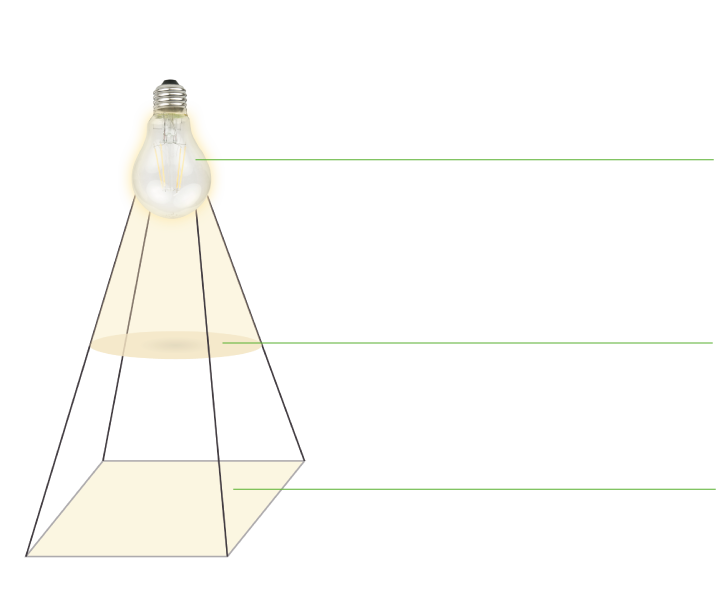
Luminous flux (lumens, lm) describes the total light output emitted by a light source in all directions.
Light intensity I (candela, cd) describes the part of a luminous flux which is emitted in a solid angle.
Illuminance E (LUX, lx) describes how much a light flux incides on a given area.
What is luminous flux?
SI unit* : Lumen (lm)
The luminous flux is the total light output emitted from a light source in all directions. The lumen already considers the sensitivity of the eye. That is to say, two light sources with the same luminous flux are perceived as equally clear regardless of their light color.
What is luminous intensity?
SI unit* : Candela (cd)
Lamps radiate in several directions - but with different strength. Light intensity indicates the luminous flux that is emitted at a solid angle (thus in a certain direction). Luminous intensity is a characteristic of the light source and has no relation to human perception. An ordinary household candle has a luminous intensity of 1 cd and therefore corresponds to one lumen per solid angle.
* Définition SI : SI est le Système International d'unités pour les grandeurs physiques.
Photometric quantities are measured quantities that quantify the brightness and lighting intensity of light sources based on human perception. Units such as lumen and lux are used to describe light intensity and lighting level.
What does lighting intensity indicate?
SI unit* : Lux (lx)
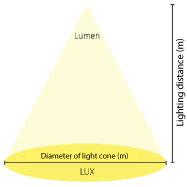
Illuminance indicates how much luminous flux incides on a defined area and is therefore calculated as the quotient of the luminous flux (lm) by the illuminated area (m²).
The illuminance developed by a light source over a given area decreases as a square of the increasing distance.
| OTHER EXAMPLES OF TYPICAL ILLUMINANCE FOR ORIENTATION: | |
| 5 mW laser pointer, green (532 nm) | 427.000 lx |
| Lightning in a modern OP | 160.000 lx |
| Clear sunny day | 100.000 lx |
| Cloudy summer day | 20.000 lx |
| Cloudy winter day | 3.500 lx |
| Sports stadium lightning | 1.400 lx |
| Office lightning | 500 lx |
| Street lightning | 10 lx |
| Candle 1 meter away | 1 lx |
| Full moon | 0,25 lx |
| CALCULATION: Luminous fl ux (lm) / Area (m2) = Illuminance (lx) | |
| ILLUMINANCE LEVELS ACCORDING TO WORKPLACE REGULATIONS | ||
|---|---|---|
| REQUIREMENT ON VISUAL TASK | RATED LUMINOUS STRENGTHEN | EXAMPLE |
| very low | 50 lx | Storage rooms, storerooms |
| low | 100 lx | Break rooms, traffic zones |
| low | 150 lx | Traffic zones with vehicles, loading areas |
| moderate | 200 - 300 lx | Work on the workbench, machine tools, rough work, reception desk at hotel |
| medium | 500 lx | Office |
| high | 750 - 1000 lx | Technical drawing, precision engineering, printing |
| very high | 1500 lx | Watchmaker‘s workshop, electronics workshop |
| exceptionally high | 2000 lx | Engraving, invisible mending |
Luminance: What is the difference to lighting intensity?
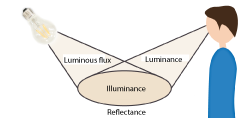
The illuminance expressed in Lux is a recipient variable, i.e. it describes the light output inciding on a given surface. The luminance, however, describes the perceived light that is emitted by a surface (whether this is used as light source or as a reflector). Luminance is the quotient of the luminous intensity (cd) and the surface perpendicular to the radiation direction (A).
| CALCULATION: Luminous intensity / (cd) Area (m 2) = Luminance (LV) | ||
 |
| CALCULATION: Luminous fl ux (lm) / Power (W) = Luminous efficiency (s) |
| THE LIGHT YIELD IN COMPARISON: | |
| Bulb 60 W | 10 lm/W |
| Bulb 100 W | 15 lm/W |
| Energy-saving lamp | 50 lm/W |
| Fluorescent tube 40 W | 55 lm/W |
| LED | 200 lm/W |
Understanding luminous efficacy: Effectiveness of illuminants
The luminous efficiency describes the efficiency of a lamp and is derived from the emitted luminous flux (lm) and the added electric power. Its unit is therefore lm/W.
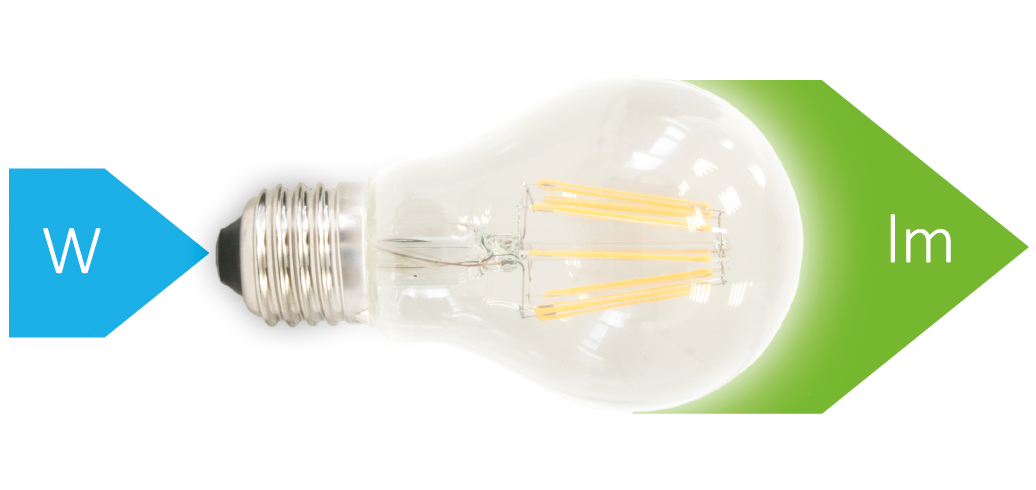
Photometric quantities such as luminous flux (measured in lumens), luminous intensity (measured in candelas) and lighting intensity (measured in lux) play a decisive role in the evaluation of lighting systems in terms of their light quality and quantity.
Color temperature: Insights into light colors
SI unit* : Kelvin (K)
Colour temperature helps determine quantitatively the colour impression of a light source. Colour temperature is the temperature of a black body** belonging to a particular colour of light emanating from the lamp. Upon heating a black body, the light colour changes from dark red to orange and yellow white to blue white.
| CHARACTERISTIC LIGHT COLOURS ACCORDING TO DIN 5035 |
| LUMINOUS SOURCE | COLOUR TEMPERATURE IN KELVIN |
|---|---|
| Warm white | < 3.500 K |
| Neutral white | < 5.300 K |
| Daylight white (also cool white) | > 5.300 K |

* Definition of SI: SI is the International System of Units for physical quantities.
** A black body is a body that absorbs all radiation incident upon it.
Colour rendering index CRI (Colour Rendering Index)
The Colour Rendering Index (CRI) is specified in Ra and expresses the colour rendering quality of luminous sources. Unlike neutral and cold white light, warm white light has a high amount of red. This leads to different colour sensations. The Ra value indicates how much of the natural colour spectrum of sunlight is reflected by a lamp. A light bulb reaches a value of 100 Ra, while a white LED lamp attains Ra values between 70 and 98. The higher the colour rendering index, the better the colours of an illuminated object are perceived.

Frequently Asked Questions About Photometric Quantities
"Luminous flux (Lumen, lm): Indicates the total amount of visible light emitted by a light source. It shows how “bright” a lamp is overall, regardless of direction or surface area.
Luminous intensity (Candela, cd): Describes how strongly light is emitted in a specific direction. It is crucial for targeted illumination of individual surfaces or objects.
Illuminance (Lux, lx): Shows the amount of light per square meter falling on a surface. This measurement is particularly important for planning workplaces, offices, production halls, or presentation areas.
Practical example: A LED panel with high luminous flux provides a lot of brightness, luminous intensity shows how the light is distributed, and illuminance indicates how intensely a surface is lit."
"Illuminance (Lux) is calculated from the luminous flux (Lumen) and the illuminated area (m²):
Illuminance (lx) = Luminous flux (lm) ÷ Area (m²)
Practical example: If a 2,000 lm LED panel illuminates an area of 10 m², the illuminance is 200 lx. This allows planning in advance how many lights are needed to achieve a standard illuminance (e.g., 500 lx in an office)."
"Luminance (cd/m²) describes the light emitted by a surface in a specific direction. It is important for assessing glare and reflections, e.g., on screens or glossy surfaces.
Practical example: A light fixture can emit a lot of light (high luminous flux), but with narrow emission, luminance at a point can be very high – this must be considered for workplaces or sales areas."
"Luminous efficacy (lm/W) shows how efficiently a lamp converts electricity into light:
Luminous efficacy = Luminous flux (lm) ÷ Electrical power (W)
Practical example: A LED panel with 2,000 lm at 20 W has 100 lm/W. The higher the luminous efficacy, the lower the electricity costs and heat generation. ISOLED products are characterized by high luminous efficacy, saving energy and costs in the long term."
"Incandescent lamps: 10–15 lm/W
Fluorescent tubes: 55 lm/W
Energy-saving lamps: 50 lm/W
LEDs: 100–200 lm/W
Practical example: ISOLED LED solutions allow energy-efficient planning even for large areas, e.g., offices, industrial halls, or retail spaces, thanks to high luminous efficacy."
"Color temperature (Kelvin, K) describes the light color of a fixture:
Warm white (2,700–3,000 K): Cozy, comfortable atmosphere, e.g., for hotels or living spaces.
Neutral white (3,500–4,000 K): Balanced light effect for offices and workplaces.
Daylight white (5,000–6,500 K): Promotes concentration, ideal for labs, workshops, or medical areas.
Practical example: ISOLED offers a wide range of color temperatures that can be combined project-specifically, e.g., with DALI dimming for individual lighting moods."
"CRI indicates how naturally colors are rendered under the light source (scale 0–100).
Practical example: For retail spaces, exhibitions, medical facilities, or laboratories, a CRI ≥ 90 is important to display colors accurately. ISOLED LED solutions offer high CRI values, enhancing visual quality and safety."
"Light distribution shows how light spreads in a room – wide, narrow, or asymmetric.
Practical example: Narrow beam angles are efficient in corridors or hallways, while wide distribution is suitable for sales areas. ISOLED provides photometric datasheets, enabling planners to position lights optimally."
Photometric values allow precise planning: number of fixtures, spacing, orientation, power consumption, and energy efficiency. ISOLED supports with datasheets and light calculations to ensure projects are efficient, compliant, and cost-effective.
Analyze luminous flux, illuminance, color temperature, and CRI. ISOLED provides comprehensive data, including light distribution diagrams, so planners can choose the optimal fixture for offices, industrial halls, schools, or retail spaces.
Yes, differences arise from LED chip type, driver quality, beam angle, and color temperature. ISOLED tests all products in its own laboratories to ensure consistent light quality, high efficiency, and low flicker values.
Do you have any questions?
If you have any questions about photometric quantities, we are here for you! Fill out our form and we will get back to you as soon as we have processed your enquiry.
Register now!
Register and take advantage of the many exclusive benefits and discounts for ISOLED customers.