
INRUSH CURRENT LIMITER
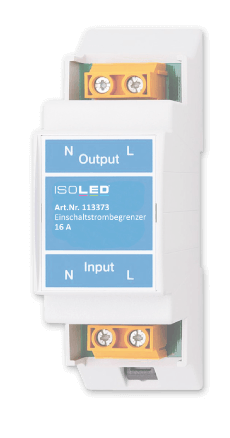
Inrush current limiter: Optimum solution for LED lighting systems

Inrush current limiter in a nutshell:
The startup current limiter (SCL) from ISOLED® is designed for LED lighting solutions and limits the starting current for up to 300 milliseconds to prevent fuses from blowing.
It is specially designed for capacitive loads and is self-powered without an additional power supply unit. The SCL is installed between the back-up fuse and the loads and enables precise limitation of the inrush currents, which extends the service life of the circuit breakers. By using the SCL, more LED power supply units/loads can be connected per upstream circuit breaker, which leads to a significant reduction in installation and material costs.
Inrush current limiter (ESB) for capacitive loads
Why inrush current limiters important?
When switched on, LED power supplies draw a high starting current for a period of up to 300 milliseconds compared to traditional lighting systems - this can be many times the rated current (e.g. 24 V/150 W transformer: rated current 6 A, inrush peak/start-up current 20 A). This means that only a few simultaneously switched-on loads are sufficient to trigger the circuit breaker to trip. Frequently installed B16 miniature circuit breakers are triggered from 5 times the 16 A rated current (i.e. 80 A). If you change to a C16 miniature circuit breaker which only trips from 10 times the 16 A rated current, this means a tolerable starting current of up to 160 A. Here, however, there is a risk that, depending on the loop impedance, the circuit breaker may not trip in the event of a short circuit, provided the maximum length of the spur lines is not limited and their cross-section is not increased. (With D automatic circuit breakers the danger is considerably greater!)
What alternatives are there?
Often attempts are made to use a simple inrush current limiter instead of a miniature circuit breaker with a different tripping characteristic. However, these ESBs usually only limit for too short a period. Even a soft start is not the best solution for limiting the inrush current, as it is not compatible with current LED technology.
Up to 70% reduction of the installation/costs of materials
RETROFITTING IN EXISTING LIGHTING SOLUTIONS POSSIBLE WITHOUT PROBLEMS!

The ISOLED® startup current limiter - the perfect solution!
The perfect solution for this well-known problem when converting to LED or for a new installation is the use of the ISOLED® inrush current limiter with a significantly longer limiting time. It is designed for the optimum design of typical LED lighting networks and is highly effective in preventing fuses from blowing (also to the benefit of fuse life). The ESB is installed between the circuit breaker and the consumer and limits the inrush current for 300 ms.
MOST IMPORTANT DATA
Effective/peak current limiting of capacitive loads | ESB cuts current peaks from 48 A (33.9 A effective)
Rated power 16 Ampere
Nominal voltage 184 - 265 Vac
Integrated resistor 6,000 μF
Max. 3 switch-on operations per minute
Ambient temperature: -40° to +70° C
Integrated bypass relay
Temperature monitoring against overload and for fire protection
Protection class IP20
Smallest recommended circuit breaker B13A at 30
Ambient temperature
Service life 384,000 hours
Spring cage terminals 0.5 - 6 mm²
NO EXTERNAL POWER SUPPLY NECESSARY!
Art.Nr. 113373
The startup current limiter from ISOLED® effectively limits the starting current for LED lighting solutions and extends the service life of the circuit breakers. With a rated voltage of 184 - 265 Vac and a rated power of 16 amps, it offers a reliable solution for capacitive loads.
Advantages of inrush current limiters

Precise and repeatable
inrush current limitation

Reliable prevention of the
tripping of circuit breakers

Significantly more LED power supply
units/consumers per upstream
circuit breaker possible

Effective cross-section reduction for
spur lines - enormous copper savings

Extending the life of
the circuit breakers

Developed and produced in DE

Reduction in installation costs
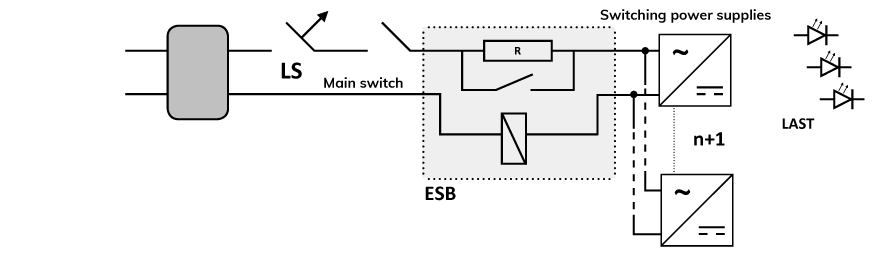
INSTALLATION WITH ESB
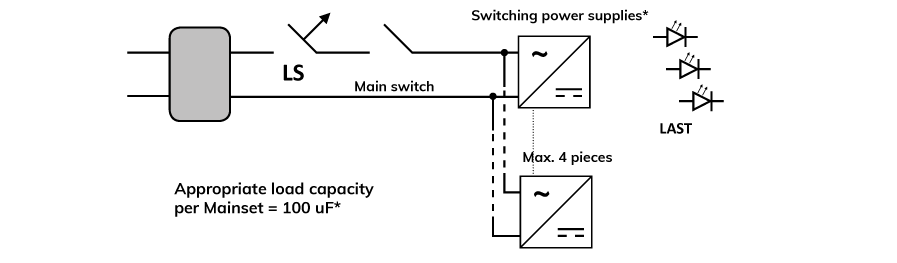
CONVENTIONAL INSTALLATION WITHOUT ESB
For the duration of 300 ms limitation of current peaks
This ESB is approved for capacitive loads and designed for networks with 230 VAC 16 A (mains frequency 16 1/3 - 440 Hz). It is self-supplying - therefore no additional power supply unit is required - and is installed between the backup fuse and the consumer. The current limiting duration (tone = 300 ms) is set so that the limitation remains active for the same period of time until the input capacitors of the connected ballasts/consumers are charged and the backup fuse no longer trips.
Time delay for short power failures
In the event of an intended mains switch-off or an unexpected mains failure, the elapsed time (Toff) is measured in the internal measuring circuit of the ESB. Only after this defined time Toff (= 500 ms) has elapsed is the bypass of the limiting circuit cancelled. When the mains supply is restored, the ESB again limits the starting current.
IMPORTANT

The consumer is connected to the power supply system in such a way that the line protection switch as well as a residual current circuit breaker can always be tripped within the legal standard - even during the period of current limitation.
Dimensioning of the ESB
This ESB operates within a tolerance range of +/- 6% of the nominal value. It is not the peak current but the effective current that must be taken into account when designing the upstream miniature circuit breakers. Since a thermal tripping point is never reached even with extremely fast miniature circuit breakers, the magnetic tripping current is decisive for the calculation of the dimensioning. For a simple consideration of the effective current, the following rule of thumb suffices:
Calculation of tripping current
I(top) x 0.707 (Calculation factor) = I(effective)
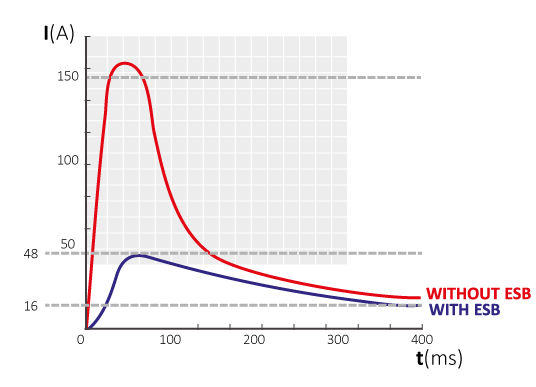
Functionality using an example with B16 automatic circuit breakers
For the ESB of ISOLED® Item no. 113373, we recommend a B13A as the smallest automatic circuit breaker. In the illustration shown here, you can see how the inrush current limiter works in conjunction with a B16 automatic circuit breaker. A B16 automatic circuit breaker trips from 3 to 5 times the 16 A rated current. This means that it starts at 48 A at the latest. The effective value responsible for the magnetic tripping current of a miniature circuit breaker is 0.707 times lower than the peak current. The intermediate inrush current limiter limits the starting current to 48 A (33.9 RMS) for 300 ms (tone), thus preventing the B16 circuit breaker from tripping.
Questions and Answers About Inrush Current Limiter
The Inrush Current Limiter (ESB) is an electronic module that temporarily (up to 300 ms) limits the initial current surge when switching on LED power supplies. This prevents high current peaks that could trip fuses or damage relay contacts, allowing higher loads per circuit.
The ESB is installed between the fuse/circuit breaker and the load. It limits inrush current for the first ≈300 ms until LED driver capacitors are charged. Afterwards, an internal relay bypasses the ESB. The device is self-powered and includes temperature monitoring and a bypass function.
- Peak current limitation: approx. 48 A (≈ 33.9 A RMS)
- Rated current: 16 A at 184–265 VAC
- Maximum 3 switch-on events per minute
- Temperature range: –40 °C to +70 °C
- Protection class: IP20
- Spring terminals for conductor cross-sections 0.5–6 mm²
- Integrated resistor and capacitor (e.g., 6,000 μF)
- Prevents circuit breakers from tripping due to peak currents
- Allows more LED drivers per circuit
- Reduces material costs (smaller conductors, fewer fuses)
- Retrofit capability in existing installations
- Extends lifespan of fuses and relay contacts
Especially in large LED installations with many parallel power supplies or high start-up loads. Also useful in retrofits to manage peak currents without major rewiring.
Via our contact page or phone, an experienced inside-sales expert will review power requirements, load distribution, and provide a tailored solution with installation guidance and quotations.
The ISOLED ESB is designed for a maximum of 3 switch-on events per minute. Frequent rapid switching may impair functionality or cause overheating.
With limited peak currents, smaller conductors can be used in some cases. Loop impedance must still ensure proper short-circuit and overload protection. The ESB only acts during the first 300 ms; afterward normal current flows.
After shutdown, the ESB measures ~500 ms internally. During this time, the bypass remains active so that on restart, current is again limited until capacitors are charged.
Lower trip ratings can be used. ISOLED recommends B13A instead of B16 as a minimum breaker when the ESB is correctly applied.
It is designed for capacitive loads typical of LED drivers and works with most LED systems. It can be retrofitted in existing installations if electrical parameters are followed.
In normal operation, the ESB is bypassed and has negligible effect on efficiency or energy use. Temporary limiting during the first 300 ms produces minimal losses.
Do you have any questions?
If you have any questions about inrush current limiters, we are here for you! Fill in our form and we will get back to you as soon as we have processed your enquiry.
Register now!
Register and take advantage of the many exclusive benefits and discounts for ISOLED customers.